Hydration · IV Therapy
IV Therapy vs Drinking Water: Is IV Hydration Really Better?
July 14, 2026 · 6 min read · The IV Hub Wellness
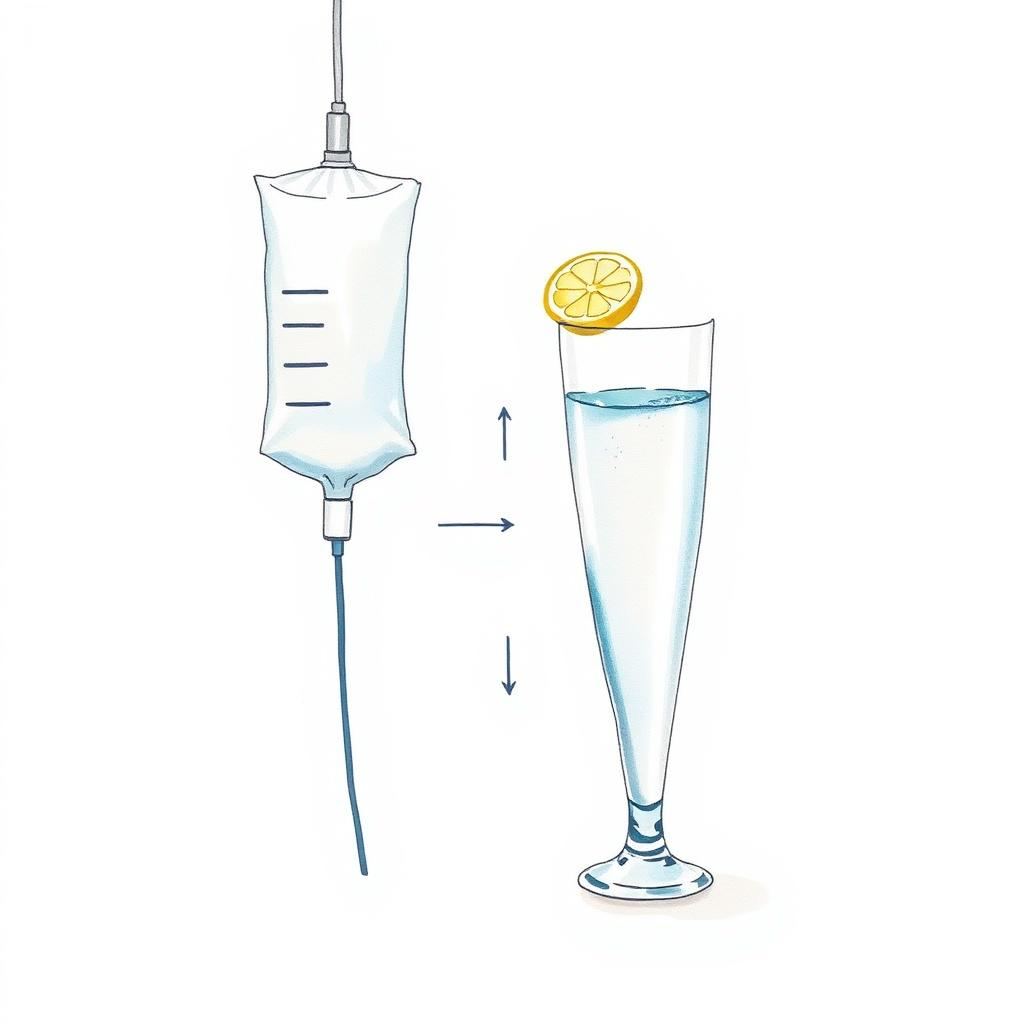
The most honest answer to "should I get an IV or just drink water?" is: it depends on what your body needs and how fast it needs it. Both work. They just work on completely different timelines and completeness levels. Here is a clinician's take on when each option is the right one — no marketing spin.
How Oral Hydration Actually Works
When you drink a glass of water, it travels to the stomach, then the small intestine, where it is absorbed through the gut wall into the portal circulation, filtered through the liver, and finally distributed to tissues. Under ideal conditions, 40 to 60% of what you drink reaches your bloodstream over the following 1 to 2 hours. The rest is either excreted or held in the gut.
Oral hydration works well for baseline daily needs and mild dehydration. It fails when the gut is compromised — nausea, vomiting, hangover, GI illness — or when you need rapid volume replacement.
How IV Hydration Works
An IV bypasses the gut entirely. Sterile normal saline (0.9% NaCl) is delivered directly into a peripheral vein, meaning 100% of the fluid enters your bloodstream. A 1-liter bag typically infuses over 30 to 60 minutes. Because the fluid is isotonic — matched to your body's own salt concentration — it distributes evenly across the extracellular and intracellular compartments without diluting plasma sodium.
Add electrolytes, B-complex, magnesium, and vitamin C and you have not just hydration — you have targeted repletion of everything a stressor (illness, alcohol, altitude, endurance) burned through.
Side by Side
- Absorption: Water — 40 to 60%. IV — 100%.
- Time to full hydration: Water — 2 to 4 hours. IV — 30 to 60 minutes.
- Electrolytes included: Water — none. IV — sodium, chloride, plus custom add-ons.
- Nutrient replacement: Water — none. IV — B-complex, B12, vitamin C, magnesium, glutathione as needed.
- Cost: Water — pennies. IV — meaningful, but reserved for goals water cannot meet.
- Best for: Water — daily maintenance. IV — depletion, illness, hangover, migraine, athletic events, poor gut absorption.
When Drinking Water Wins
For a healthy adult with a normal diet, drinking water and electrolyte-rich foods is enough — full stop. You do not need an IV to maintain baseline hydration. Aim for pale-yellow urine, sip through the day rather than chugging at once, and get sodium and potassium from real food (fruit, vegetables, broth, olives, avocado). This is cheaper, sustainable, and effective.
When IV Wins Clearly
- Hangover. Alcohol is dehydrating, depletes B vitamins and magnesium, and irritates the gut. Drinking water helps modestly; an IV corrects all three in under an hour. Read our hangover recovery guide.
- Acute illness. When you cannot keep fluids down, IV is the only option. Read our immunity drip guide.
- Migraine. Magnesium sulfate plus fluid is the fastest way to abort a migraine outside of injectable triptans.
- Pre-event loading. Weddings, races, big performances, long flights, altitude — IV loads you ahead of demand rather than trying to catch up during it.
- Athletic recovery. Post-training or post-race, IV restores fluid, electrolytes, and B vitamins faster than any oral protocol.
- Chronic conditions. Fibromyalgia, chronic fatigue, autoimmune flares — IV therapy delivers what compromised guts cannot absorb.
A Smarter Strategy
Use both. Water and real food handle 95% of your daily needs. IV therapy handles the moments when your baseline gets overwhelmed — illness, travel, high performance days, or targeted goals like vitamin repletion and skin brightening. The clients who see the biggest results treat IV as a targeted tool, not a substitute for the basics.
The Bottom Line
Drinking water is enough for the average day. IV hydration wins any time your body is depleted faster than the gut can catch up — illness, hangover, exercise, or nutrient shortfalls. Neither is universally "better." They just solve different problems.
Recommended IV Options
Ready to put this into practice? These are the treatments our clinical team most often pairs with this topic.
IV Hydration Therapy
Custom drips for energy, immunity, recovery, hydration, and beauty — delivered directly to your bloodstream.
Learn more →Vitamin Injections
B12, MIC, Vitamin D, glutathione and more — fast, targeted delivery without the pill bottle.
Learn more →Micronutrient Testing
See exactly which vitamins, minerals, and antioxidants your body is missing — no more guessing.
Learn more →