
Wellness
Top 10 Wellness Tips for September: A Clinician's Fall Reset Guide
September 8, 2026 · 11 min read · Medically reviewed by Noreen Connolly, PhD, NP
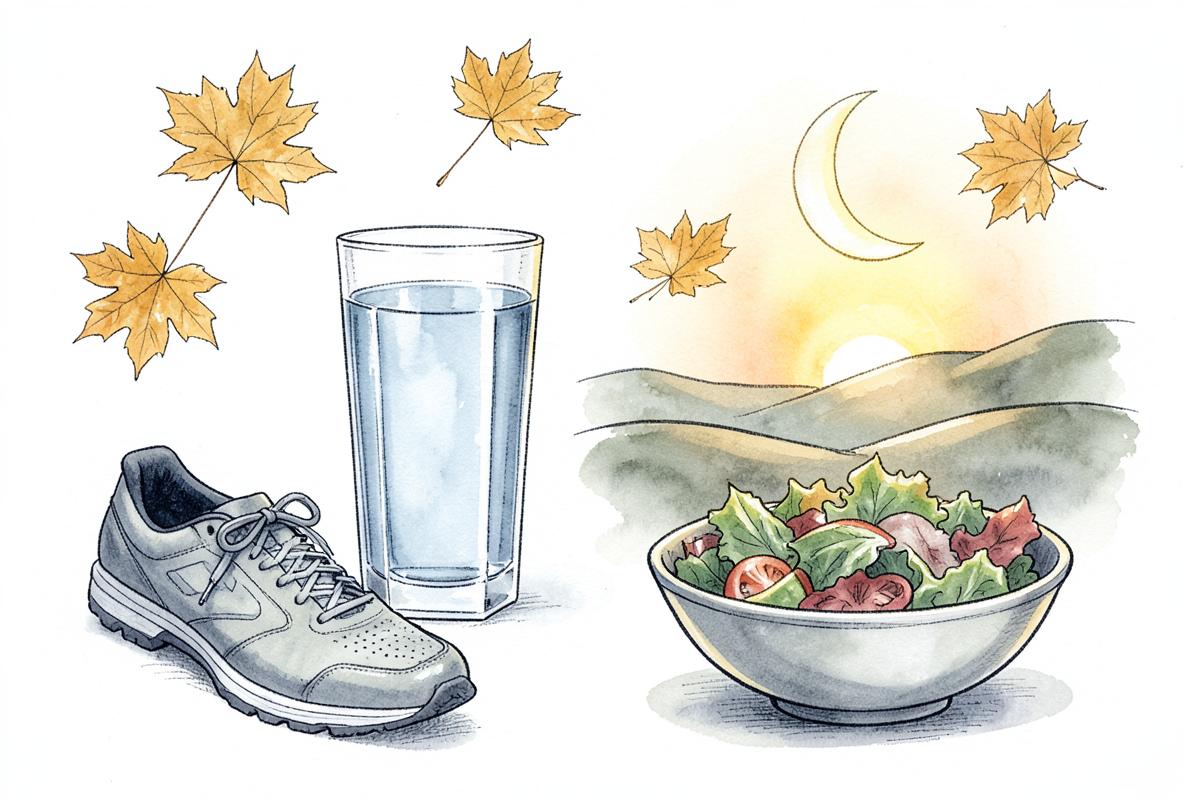
Quick answer: September is the most effective month of the year to rebuild a health routine. Schedules stabilize, daylight still supports early movement, and there is a full twelve-week runway before the holidays — exactly the window hormone therapy, medical weight loss, and nutrient repletion need to produce measurable results. The ten tips below are the ones our clinical team actually recommends to patients this month, ordered by impact.
None of these are exotic. That is the point. The people who feel genuinely better by November are rarely the ones who did something dramatic in September — they are the ones who fixed the fundamentals while everyone else was waiting for January. Here is where to start.
1. Anchor a Fixed Wake Time — Every Day
This is the highest-impact habit on the list, and it costs nothing. The cortisol awakening response — the sharp rise in cortisol in the first thirty minutes after waking — sets your energy curve for the entire day, and it is timed primarily by when you wake, not when you sleep. A wake time that swings two hours between weekdays and weekends keeps that rhythm permanently blurry, which is one reason so many people feel foggy on Monday regardless of how much they slept in.
Pick a wake time you can hold seven days a week, and pair it with ten minutes of outdoor light within the first hour. Morning light is the strongest known signal for circadian timing — stronger than any supplement — and in September the light is still there to be used. Most people report noticeably better morning energy and easier sleep onset within five to seven days.
2. Treat Sleep as a Metabolic Intervention, Not a Luxury
Short sleep is not just tiring — it is metabolically expensive. Sleeping five to six hours measurably raises ghrelin (the hunger hormone), suppresses leptin (the satiety hormone), worsens insulin sensitivity, and drives next-day intake up by several hundred calories on average. If your weight, cravings, or afternoon energy are problems, your sleep is part of the equation whether or not it feels like the cause.
September is the easiest month to fix this because schedules return to structure. Protect a seven-to-nine-hour window, stop eating two to three hours before bed, and keep the bedroom cool and dark. If you are doing all of that and still waking unrefreshed, that is a clinical finding — fragmented sleep despite good habits is a classic presentation of low progesterone, elevated evening cortisol, and sleep-disordered breathing, and all three are testable.
3. Start Vitamin D Now — Not in November
Greater Boston sits north of the 42nd parallel. From roughly October through April, the sun never climbs high enough for your skin to synthesize meaningful vitamin D, regardless of how much time you spend outside. The stores you built over summer fade within weeks. Waiting until you feel the winter slump means spending the entire fall sliding into deficiency.
The right approach is to test first and supplement to a target range rather than guessing at a dose — needs vary five-fold between individuals. Low vitamin D shows up as fatigue, low mood, frequent infections, and muscle aches, which is why it is one of the first things we check in our micronutrient testing panel every September.
4. Hit a Real Protein Target
Protein is the most under-consumed macronutrient we see on intake forms, and it underpins almost everything else on this list. It preserves lean muscle during weight loss — and muscle is the tissue that sets your resting metabolic rate. It is the most satiating macronutrient, which is what makes calorie control feel manageable instead of punishing. And it supplies the raw material for immune function heading into cold and flu season.
The target: roughly 0.7 to 1 gram per pound of goal body weight, distributed across meals rather than loaded at dinner. For most people this means deliberately building each meal around a protein source instead of treating protein as a side dish. If you are working on body composition this fall, our medical weight loss program tracks lean mass alongside weight precisely so the muscle stays while the fat goes.
5. Rehydrate for Cooler Weather
Fall dehydration is more common than summer dehydration for a simple reason: cooler temperatures blunt thirst while you keep losing fluid through breath, skin, and indoor heating. The result is a low-grade deficit that shows up as afternoon headaches, muscle cramps, dry skin, poor exercise tolerance, and fatigue that does not resolve with rest.
A practical target is half your body weight in ounces per day, front-loaded into the morning and around exercise. If you spent the summer sweating, traveling, and drinking more alcohol than usual, you may be starting September already depleted — in fluid but also in magnesium, B vitamins, and electrolytes. An IV hydration session restores all of it in under an hour at full absorption, which is a fast way to clear depletion off the list before investigating anything deeper.
6. Get Your Baseline Labs Drawn This Month
Every other tip on this list works better when you know your numbers. Fatigue, weight resistance, low mood, and poor sleep are the shared presentation of at least eight different problems — low thyroid output, low testosterone, fluctuating estradiol, low ferritin, vitamin D deficiency, insulin resistance, B12 deficiency, and chronic dehydration — and the treatment for each is different.
A September baseline panel should include a full thyroid panel (TSH, free T3, free T4), total and free testosterone, estradiol, DHEA-S, fasting insulin and glucose, HbA1c, a lipid panel, CBC, ferritin, vitamin D, B12, and magnesium. Symptoms tell us where to look; labs tell us what to do. Our Diagnostic Blueprint bundles all of it into a single draw with a results review, so you leave with a plan rather than a PDF.
7. Rebuild Your Immune Foundation Before Flu Season
Cold and flu season starts in October. Immune resilience is built in September — or not at all. The fundamentals are unglamorous and well-established: seven to nine hours of sleep, adequate protein, daily movement, and replete levels of vitamin D, zinc, and vitamin C. These are the four most common fixable gaps we find on September lab work.
Two things are worth adding. First, chronic stress is a direct immune suppressant through sustained cortisol elevation, so the sleep and stress items on this list are immune items too. Second, if you want to enter the season topped up — or you feel something coming on — an immunity-focused IV drip with vitamin C, zinc, and B-complex delivers those nutrients at full absorption when the gut is not the limiting factor.
8. Put Strength Training Back on the Calendar
Summer erodes training volume quietly — heat, vacations, and disrupted schedules — and lost training volume means lost lean mass. Two to three resistance sessions per week is the minimum that protects muscle, bone density, insulin sensitivity, and resting metabolic rate. Walking is excellent and it is not a substitute.
Book sessions as fixed calendar appointments now, while the fall schedule is still open. This is also the honest answer to the most common October question we hear — "why is my weight creeping up when nothing changed?" Usually something did change: muscle went down over the summer, and the calories that muscle used to burn are now going somewhere else. If strength training feels harder to recover from than it used to, that is worth a conversation about testosterone levels and recovery support, both of which decline with age and directly affect training response.
9. Audit Alcohol Before the Holiday Run
September sits between two drinking seasons — summer patios and the holiday stretch — which makes it the one natural window to reset. Alcohol suppresses fat oxidation for hours after the last drink, fragments the second half of sleep, raises evening cortisol, and quietly adds several hundred calories per session. It is the single highest-yield change for most people, and the least popular.
You do not need an extreme approach. A defined, written weekly limit outperforms a vague intention to "cut back," and two alcohol-free weeks is a genuinely useful experiment: most people are surprised by how much better their sleep depth, morning energy, and waistline respond. If you do indulge, hydrate aggressively the following morning — and if a celebration gets away from you, a recovery IV handles the dehydration, electrolytes, and nausea faster than breakfast and regret.
10. Book Your Appointments Before the Calendar Fills
The strongest predictor of whether a September reset survives November is whether the November appointments already exist. Hormone follow-ups, recheck labs, weight loss check-ins, and membership sessions all work on six-to-twelve-week cycles — which means the fall plan either lives on the calendar or it does not happen.
Book the sequence now: baseline labs, results review, treatment start, and the recheck. Put training sessions in as recurring appointments. If a wellness membership makes sense for your goals, it converts "I should go more often" into a standing monthly session that happens by default. Structure beats motivation every time, and September is when the structure is easiest to build.
The Bottom Line
The best fall you have ever had is decided in the next four weeks. Anchor your wake time, protect your sleep, start vitamin D with a tested dose, eat real protein targets, stay ahead of fall dehydration, and get a baseline lab panel so everything else is aimed at the right problem. Add strength training, an honest alcohol audit, immune fundamentals, and a booked appointment calendar, and you will feel the difference before the leaves finish turning.
Every plan we build is overseen by Noreen Connolly, PhD, NP, our medical director, and delivered at our four Greater Boston clinics in Medford, Stoneham, Burlington, and Danvers.
Start Your September Reset
Baseline labs, hormone therapy, medical weight loss, and IV hydration at four Greater Boston clinics.
Book a ConsultationFrequently Asked Questions
Recommended IV Options
Ready to put this into practice? These are the treatments our clinical team most often pairs with this topic.
IV Hydration Therapy
Custom drips for energy, immunity, recovery, hydration, and beauty — delivered directly to your bloodstream.
Learn more →Medical Weight Loss
Physician-supervised weight loss with metabolic testing, coaching, and personalized protocols.
Learn more →Diagnostic Blueprint Labs
Comprehensive lab panels that map your baseline and guide precise treatment decisions.
Learn more →